Space view
Start on a rooftop and zoom out to the observable universe.
No scene cuts and no loading screens. Pull back from a Manhattan block through live orbital shells, the Moon, the planets, nearby stars, and the Milky Way out to supernovae billions of light-years away.
Data from


- CelesTrak
- NASA
Exoplanet
Archive
Sky view · Planetarium on the ground
Drop onto the ground anywhere on Earth and look up.
Space and Sky share the same WebGL2 engine and live clock. Stand at 17 observatories and cities — or your own coordinates — see the night sky as your eye really sees it, or peel away the atmosphere and light pollution in one click.
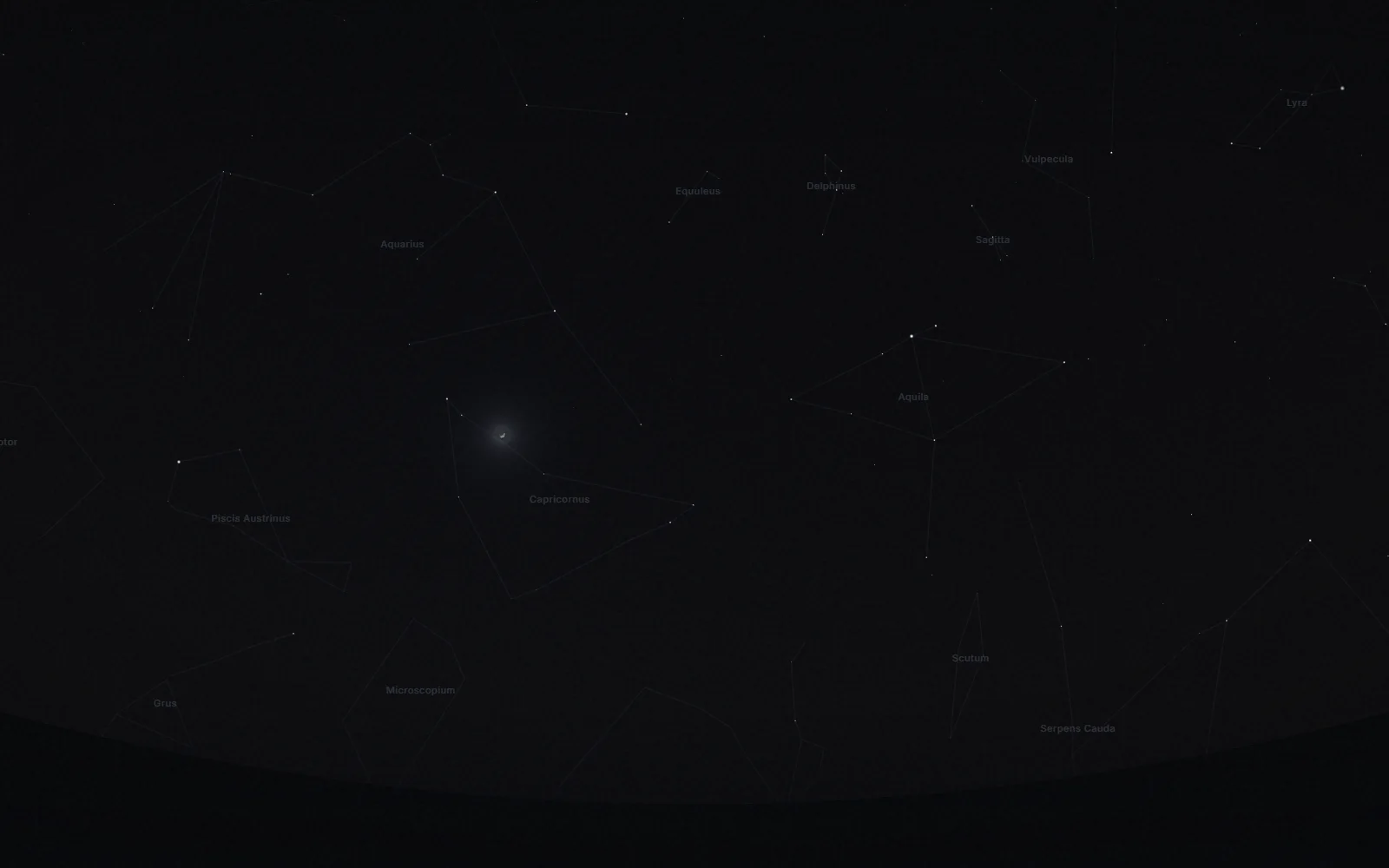
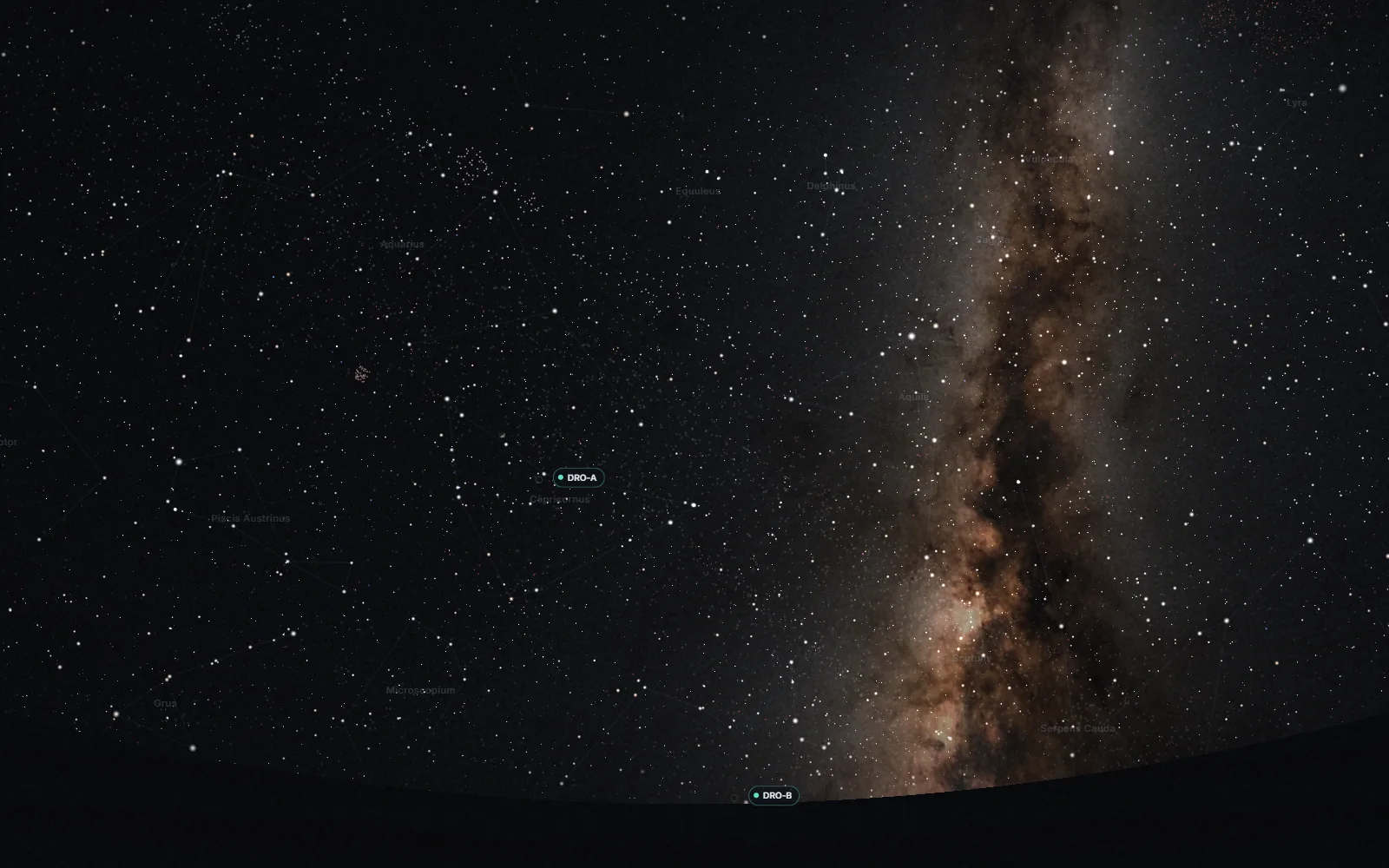
Realistic sky on, or peeled away in one click.
Drag across the night sky. With Realistic sky enabled, View Cosmos models sunlight, moonlight and its halo, and real city light pollution — dimming faint stars to what your eye can actually see from that spot. Turn it off to reveal the full Milky Way, 100,000+ stars, and satellites behind the exact same Moon and constellations.
- Independent sliders for Daylight, Moonlight, Light pollution (Bortle 1–9), and Star dimming
- Panini, Stereographic, or Flat projection with strictly level horizon and zero camera roll
- Jump between Space and Sky on any star, planet, satellite, or deep-sky object without losing your place
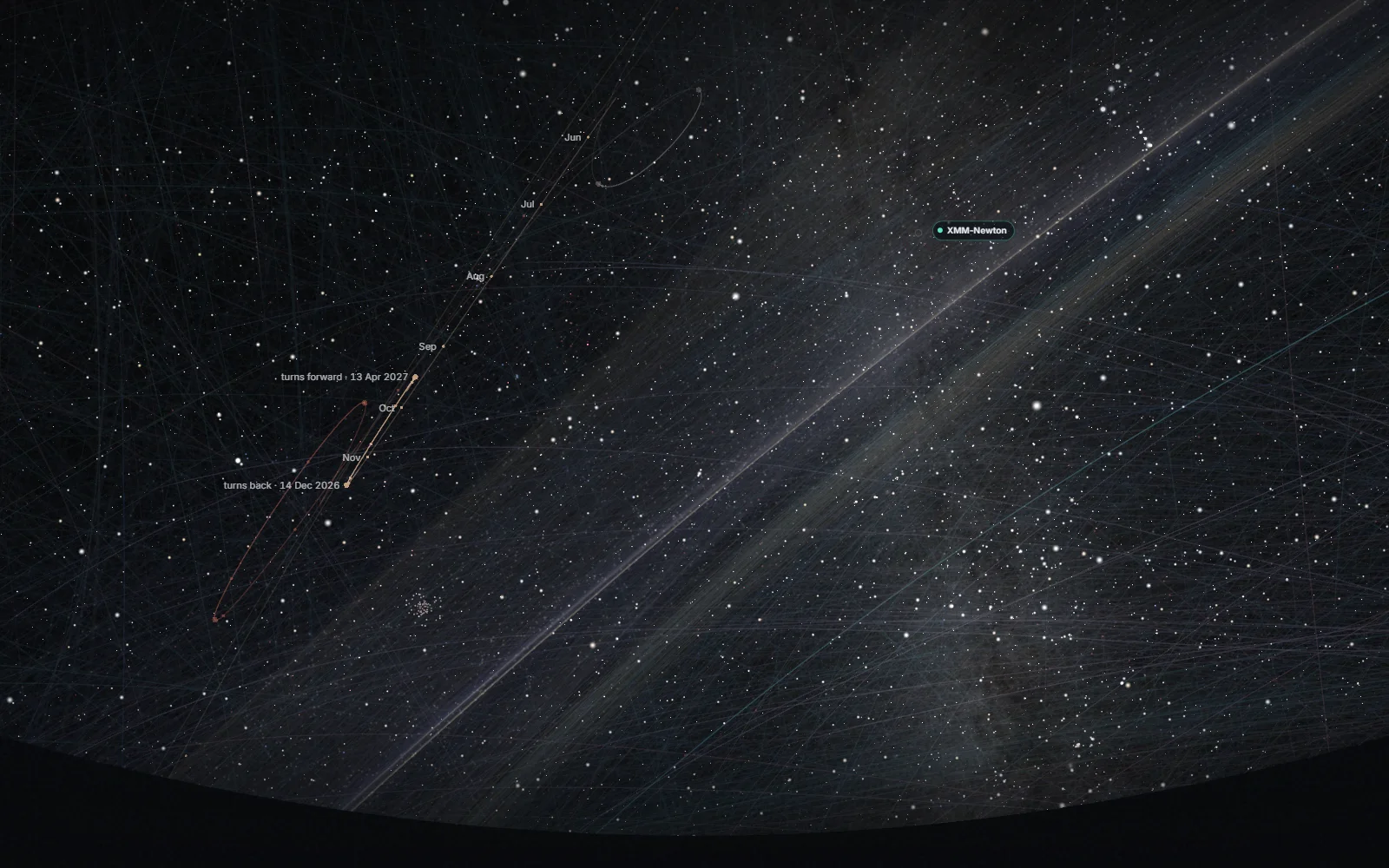
Retrograde loops and live satellites overhead
Trace Mars, Jupiter, Saturn, the Sun, and the Moon across your sky with dated turning points — while 41,344 satellites glide overhead at physical visual magnitudes and vanish as they enter Earth’s shadow.


Global light-pollution atlas
Point anywhere on Earth for a sky-brightness reading in mag/arcsec² and Bortle class (1–9), then drop straight into Sky view at that site with its real light pollution preloaded.
Earth, orbits & spaceflight
Fifty years of orbital history, down to the launch pad.
Every active satellite, spent rocket body, and tracked fragment propagates live in real time — and vanishes when you rewind the clock before its launch date.
Rewind the orbital shell to 1975.
Drag the divider between June 1975 and today from the same vantage point. Objects appear on the day they launched and disappear on reentry, revealing how the low-Earth and geostationary shells filled up.
- Filter 41,344 objects across 105 nations, 50 constellations, orbit regime, inclination, size, and radio frequency
- Seven color modes including regime, country, age, inclination, and Starlink shell
- Close-approach watch ranking the 24 closest upcoming passes between tracked objects


Street level and real seasons
Satellite tiles down to ~250 m, twelve monthly NASA Blue Marble seasonal textures, dark basemaps, and 4,381 ground stations.
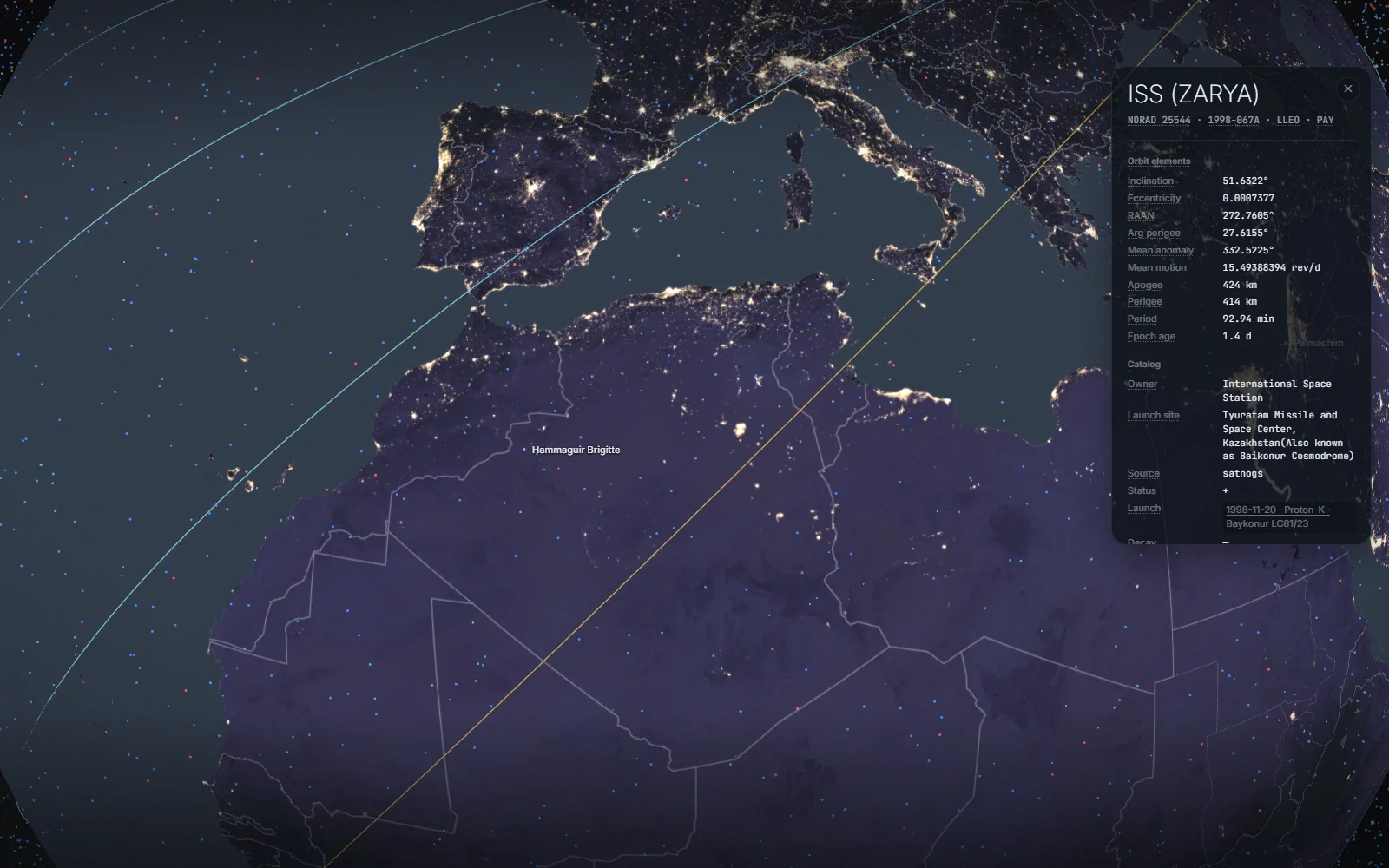
Live ground tracks & dossiers
Click any spacecraft for live altitude, velocity, footprint, SatNOGS radio frequencies (1,590 objects), and upcoming close approaches.

76,432 launches by pad
Every orbital and suborbital flight since 1942 mapped across 1,962 pads and 589 launch sites worldwide.
The Sun, the Moon & the Solar System
Five solar wavelengths, 5-meter lunar relief, and 39,000 small bodies.
Center the camera on any planet, moon, dwarf planet, or deep-space probe. Real JPL ephemerides drive every body, shadow, and reference frame.
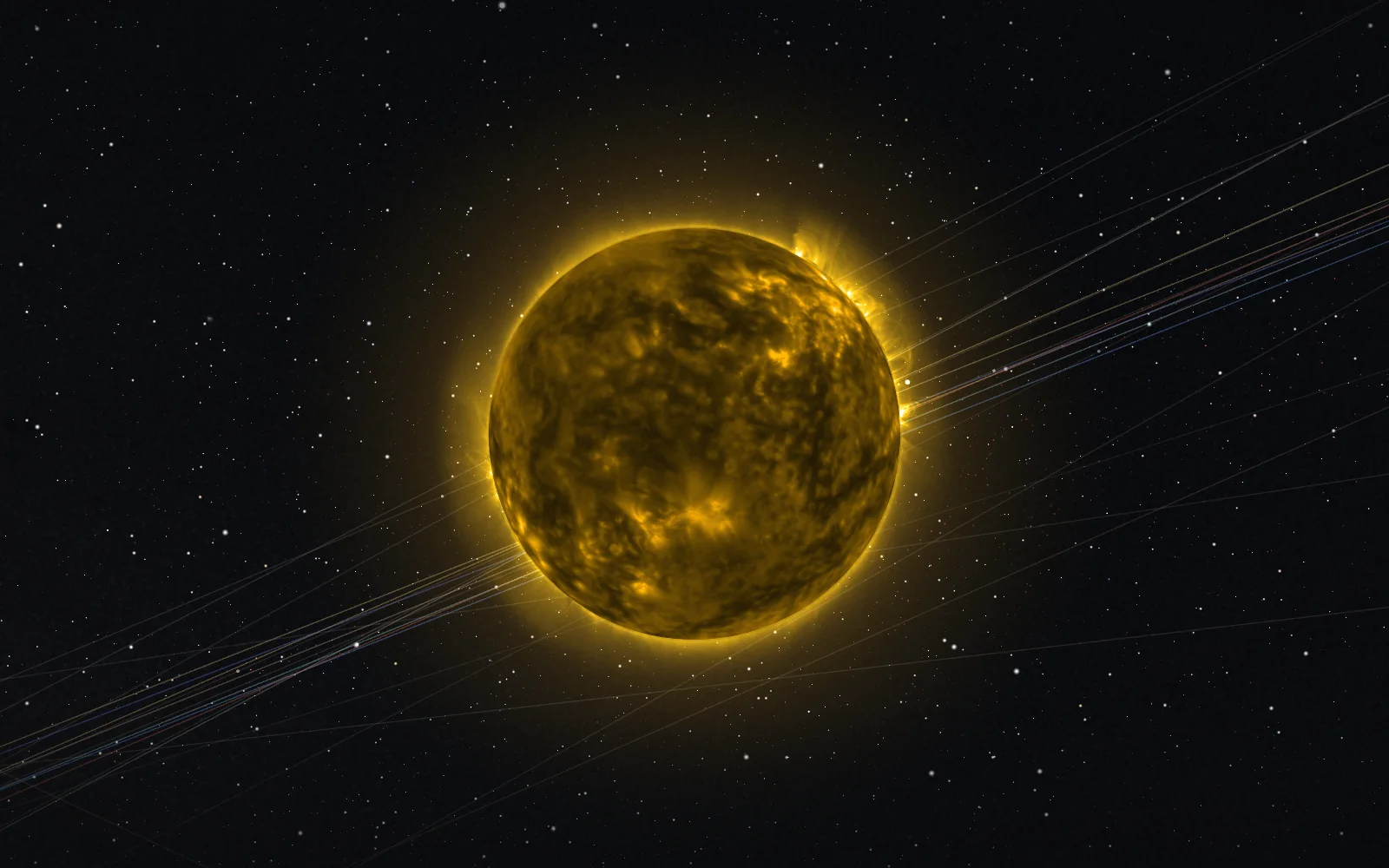
The Sun from photosphere to extreme-UV corona.
Built from a full Carrington rotation of NASA Solar Dynamics Observatory imagery at 8192×4096 resolution, paired with measured limb darkening and real off-limb coronagraph data.
- Switch live across five bands: HMI Visible, AIA 304 Å, 171 Å, 193 Å, and 211 Å
- White-light K-Cor and LASCO C2 coronal streamers in visible light; AIA EUV loops in ultraviolet
- True solar axial tilt and rotation rate synchronized to the clock


The Moon in LOLA 5-meter relief
One lunar engine shared by Space and Sky: LROC albedo, LOLA laser-altimetry height maps casting real crater shadows along the terminator, McEwen photometry, lunar eclipses, and Earthshine on the unlit limb.

Planets, moons, 39,268 small bodies & 12 probes
Eight planets, eight dwarf planets, ten major moons, five Lagrange points, 1,438 comets, main-belt and near-Earth asteroids, plus Voyager 1 & 2, New Horizons, Juno, Parker Solar Probe, and JWST.
Switch reference frames and watch orbits reshape.
Hold the Sun still for the familiar nested ellipses, or lock the frame to Earth and watch the inner and outer planets trace looping epicycles — the exact same positions, seen from where we stand.


Multi-wavelength sky · Space & Sky
See the same patch of sky across 34 all-sky surveys.
Switch the entire sky from visible starlight to glowing gas, infrared dust, radio waves, X-rays, or gamma rays — in both Space and Sky. Zoom continuously from the full Milky Way down to deep telescope plates.


- Visible & ultravioletDeep telescope mosaics that sharpen continuously as you zoom in, from the full Milky Way down to individual nebulae.
- InfraredCut straight through dark dust clouds to reveal warm star-forming nurseries and the bright core of our galaxy.
- Radio & microwaveTrace cold hydrogen gas, interstellar dust, and the cosmic microwave afterglow of the Big Bang across the entire sky.
- X-ray, gamma-ray & 1697 chartReveal pulsars, superheated gas, and active galaxies — or wrap Vincenzo Coronelli’s 1697 engraved celestial globe over the real stars.
Stars, exoplanets & deep space
Leave the Solar System behind.
Fly through 116,495 stars in true 3D parallax, inspect atomic spectra calculated on the fly, explore 6,336 confirmed exoplanets, and exit the Milky Way toward 1,543 Type Ia supernovae.

116,495 stars in 3D
Gaia DR3 parallaxes and proper motions joined to AT-HYG: step forward or back thousands of years and watch constellations distort as stars move through space.

Live Saha–Boltzmann spectra
Every star computes its absorption lines from NIST atomic physics at its temperature and shifts every wavelength by its measured radial velocity.

6,336 planets around 4,749 stars
Every confirmed world in the NASA Exoplanet Archive, plotted at its host star with mass, radius, orbital period, equilibrium temperature, and discovery method.
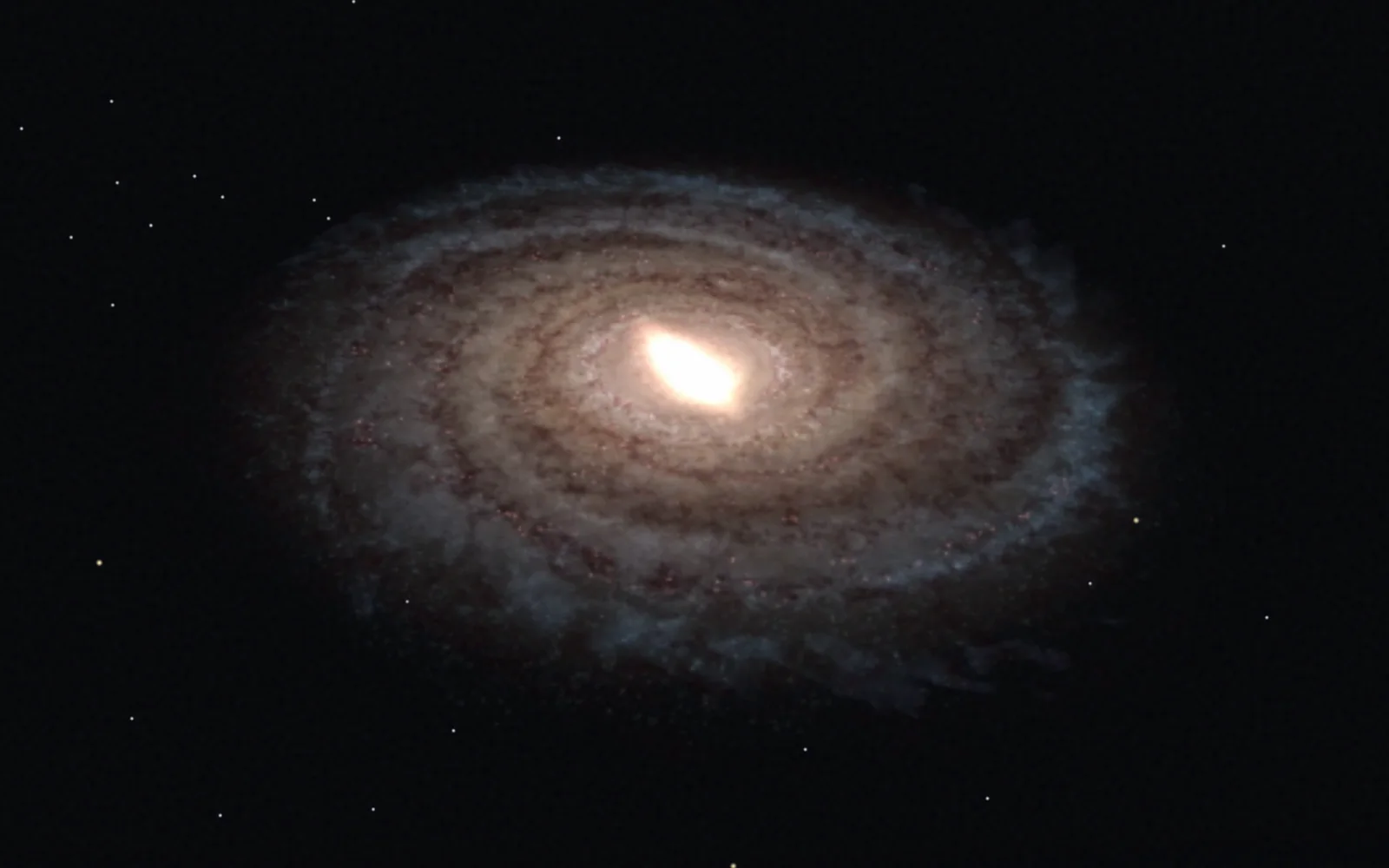
3D Milky Way & 1,543 supernovae
Volumetric dust and starlight as you leave our galaxy, surrounded by 63 Hubble/Webb targets at true distances and Pantheon+SH0ES supernovae flaring on the dates they were discovered.
Databases, library & reference
9 searchable databases, 1,920 space photos, and 144 sourced articles.
Filter any column, search a sky cone, inspect side-sheet dossiers, export your filtered match to CSV, or jump straight to that object in Space or Sky.

Stars
116,495 stars with Gaia DR3 astrometry, spectral classes, photometry, exoplanet links, and live spectra.

Exoplanets
6,336 confirmed worlds with complete NASA Exoplanet Archive fields and discovery filters.

Launches
76,432 launches since 1942 with annual charts, outcomes, mission details, and playback timeline.

Rockets
1,761 launch vehicles drawn to scale, with stages, propellants, engines, and full flight records.
1,920 Hubble, Webb & spacecraft photos, full screen.
Browse curated photography for 76 Solar System worlds and 63 deep-sky objects. Zoom deep into high-resolution plates, compare Hubble and Webb views side by side, and see every target’s location in space and in your sky.


Learn — 144 sourced articles
Click any field or control label in the app to open its definition, equations, caveats, and primary references.

Sources — 236 space archives
A curated directory of canonical astronomy and spaceflight catalogs, APIs, imagery archives, and tools across 11 subjects.

Subject index
Five entry points — Spaceflight, Solar system, Stars, Exoplanets, and Deep sky — linking every table, photo, source, and article.
Clock & links
Right now, or any date you want.
Space and Sky run on the same clock. Satellites, planets, lunar shadows, sunsets, launches, and stars stay locked together.
- Live
- Opens on the current second in real time.
- Time warp
- Run from real time up to a year a second, or drag to sweep a century per second forwards or back.
- Any date
- Type dates naturally — “next Friday 3pm” or “1969-07-20” — and bookmark moments you return to.
- Shareable URLs
- Links preserve the view (Space or Sky), timestamp, coordinates, selection, and active filters.
Provenance
Built on open scientific data.
- CelesTrakOrbital elements and public satellite catalog
- SatNOGS, Libre Space FoundationSatellite radio transmitters · CC BY-SA 4.0
- GCAT, Jonathan C. McDowellLaunches, vehicles, sites and payloads · CC BY 4.0
- The Space Devs, Launch Library 2Mission details and launch schedule · CC BY 4.0
- NASA JPLSolar System ephemerides, spacecraft, asteroids and comets
- NASA SDO (HMI & AIA)Full-rotation Sun maps in five wavelengths
- HAO K-Cor & SOHO LASCOWhite-light solar corona
- NASA LRO (LROC & LOLA)Lunar surface albedo and 5 m laser altimetry
- David Lorenz Light Pollution AtlasGlobal 2024 night-sky radiance and Bortle model
- CDS Aladin HiPS & WorldWide Telescope34 multi-wavelength all-sky surveys
- NASA Exoplanet ArchiveConfirmed exoplanets and host parameters
- ESA Gaia DR3Star positions, parallaxes and proper motions · ESA/Gaia/DPAC
- AT-HYGMerged optical star catalog · CC BY-SA 4.0
- NIST Atomic Spectra DatabaseSpectral lines for Saha–Boltzmann stellar plates
- Pantheon+SH0ESType Ia supernova cosmology and distances
- NASA Goddard SVSDeep Star Maps, Milky Way Anatomy, CGI Moon Kit
- NASA Blue Marble & Black MarbleMonthly Earth imagery and night lights
- ESA/Hubble & ESA/WebbDeep-sky photography · CC BY 4.0
- USGS AstrogeologyPlanetary surface maps
- OpenSpace3D Milky Way volume · MIT
- Natural Earth & d3-celestialCoastlines, cities and IAU constellation figures
Get early access when View Cosmos opens.
Leave your email and we’ll send a single invitation when the doors open.